
Decluttering
The Best Way to Declutter a Home if its Exceeded Its Clutter Threshold
The Best Way to Declutter a Home if it has Exceeded Its Clutter Threshold
You may be tempted to want to start dealing with all the visible clutter you see first, because it’s driving you crazy, but if your home has surpassed its clutter threshold, read this post before you take another step. In it, I share the best way to declutter a home successfully without wasting your time and energy.
If your home feels chaotic and disorderly, or if you feel like you are constantly trying to tidy up and not having much success. There might be a reason behind your frustration. There are lots of root causes behind why clutter and disorganization can become an issue in a home. They can include not having taken the time to assign permanent homes to your belongings in the first place. And of course, good organizing habits and effective storage systems play an important part as well.
But by far the most common clutter-culprit that I encounter is simply a “too much stuff issue.” At least 90% of the homes I enter have exceeded their “clutter threshold.”
I frequently find storage spaces that are bursting at the seams, pantries filled to the brim, and closets so full, they are no longer usable. Once your home’s closets, cabinets, drawers, and other storage areas have reached and exceeded their maximum capacity, it becomes impossible to put anything away, find anything, and assign homes to things.
7 Signs Your Home Has Exceeded Its Clutter Threshold:
1. Your cabinets, drawers, closets, etc., are all filled to the max. Every time you open a door or drawer, things spill out. If you need to retrieve something, you must remove or knock over other items to reach what you are looking for.
2. You have lots of things you haven’t seen in ages because they are sitting behind other things. Therefore, you have no idea what’s hiding in the back of your cabinets and shelves, or at the bottom of your drawers.
3. Your Storage Spaces have become less functional, for example, every time you enter your closet to find an outfit, you waste time looking for things and end up frustrated. It’s a hassle to retrieve and put anything away because too much stuff is crammed in there.
4. Every time you organize your home and get everything put away, it all seems to return in no time. Additionally, even when your home has just been tidied up, it still looks cluttered.
5. Multiple items are sitting around your home (on the floor or on furniture) that never get put away because they don’t have a home, and you can’t figure out where to put them. Many surfaces remain partially or completely covered with things you can’t find a place for.
6. Every time you manage to organize one room in your home, you are forced to clutter up a different room to clear out the first one. I call this “shuffling.” This is a common decluttering mistake; if you are only moving your things from one room to the next, you will never finish decluttering.
7. Your home generally feels chaotic and messy. You are constantly looking for things, and even end up wasting money buying things you already have but couldn’t find.

A home’s maximum clutter threshold is determined by how much stuff it can comfortably store in its storage spaces and still be functional.
Think of your house as a giant pantry. If it is not overstuffed, you should be able to put away, store, find, and retrieve things with minimal effort. Everything has a place, is easily assessable, and your pantry is relatively user-friendly.
But once your pantry is overloaded and its bins and shelves are spilling over, family members stop putting food where it goes. Instead, they toss it wherever they can find room to shove it. Once this happens, you start to lose control of your pantry and its inventory.
At some point, everyone gives up trying altogether, and that’s when chaos really takes over. It is likely frustrating to even walk into your pantry, let alone use it. It is no longer functional. You can apply this same theory of functionality to your whole house.
The best way to declutter a home if it has exceeded its clutter threshold:
It’s tempting to dive in and start dealing with the visible clutter on flat surfaces, furniture, and floors, because just having to look at all that clutter is driving you crazy. But you will have more success if you start decluttering from the inside out.
The visible clutter you see is likely to consist of newer items that have accumulated there more recently, due to a lack of space. But it’s what’s buried and hidden inside your storage spaces that needs to be evaluated and possibly eliminated.
To find all the unused, forgotten, and ancient things of yesterday that you are more likely to be ready to part with, you will need to go digging deep inside your closets, cabinets, and other storage spaces. By decluttering these areas first, you will be clearing out and making room for many of the things that are currently homeless and sitting out in the open.
The best way to declutter a home successfully and waste as little time and energy as possible is to work from the inside out.
Follow these steps:
1. Declutter one space at a time and finish it completely before you begin another space. This will not only prevent you from becoming overwhelmed, but will also allow you to clearly see your progress. This is important because it will help motivate you to keep going.
2. If you’re working in a large room, break that room down so that you don’t get overwhelmed. For example, in a kitchen, declutter just the pantry. Once that’s done, move on and declutter one cabinet or drawer at a time. Continue this method until your whole kitchen is done.
3. Avoid simply opening a cabinet door and searching for items to let go of. Instead, take everything out of the cabinet. Then, only put back those items that you want to keep. There is a mindset shift here…focus on letting go of everything except what you want to keep rather than on keeping everything except what you want to get rid of.
4. If you have a large decluttering job ahead of you, avoid starting with a difficult category. Keepsakes, paperwork, junk drawers, jewelry, and photos are more time-consuming and challenging clutter categories to deal with. Instead, focus on bathrooms, closets, bedrooms, and the kitchen first. It will be easier for you to face those more challenging and slower-progressing categories once you are on the homestretch.
5. As you declutter, be selective about what you keep, and ruthless about what you let go of. The more effectively you can reduce the excess clutter in your home, the more likely your hard work will pay off in the end.
6. The last step in the decluttering process should be to put away and assign homes to all of the visible things sitting around your home. This step should be much more doable once you have created storage space for them.
One Last Tip For Success:
Accept that you may have to get uncomfortable and let go of some of those items that you don’t use but “might use someday” (or maybe not). This is the most common excuse that pops up when decluttering. As you work, stay grounded by focusing on the bigger picture: Your goal is to create a functional, clutter-free, and welcoming home you enjoy coming home to.
The gain is so worth the pain!


About Laura
Who I am is a Southern California turned small-town, Midwest Mom. I am wife to Bruce and mom to my three girls. I am also dog mom to Ollie and Gracie, our quirky pups.
With a B.A. degree in Psychology, I have several years experience working with families and seniors. I believe in a holistic view to organizing. Clearing our minds of the clutter and chaos in our lives is just as important as clearing our physical clutter. By taking a holistic approach to organizing, we can make lasting change.
Back when I first started my professional organizing journey in 2013, I had what I thought of as a dirty little secret. I have ADHD and although I am organized, and enjoy the process of sorting, and tidying. I knew that there were many others with ADHD who really struggled with staying organized. I had a case of imposter syndrome and mostly kept the fact that I had ADHD to myself. That is until I learned that there are other successful professional organizers who have also learned to compensate for their ADHD the same way that I have.
I eventually realized that my need for order and simplicity actually stems from having ADHD as a way to compensate for my short attention span. So my gifts and my challenges are all ironically tied together to create who I am, and I am able to relate to and help others as a result of this coping method that I have developed for myself.
I also help those without ADHD, who struggle with too much clutter. Because simplicity and less clutter are always at the heart of staying organized, there is much overlap when it comes to finding solutions to clutter and disorganization.
I am dedicated to keeping my life as simple as possible and to helping others do the same by teaching them how to declutter their homes, simplify their lives, and manage their busy families better.
I have been helping others stay organized since 2013.
It is my deepest hope that you will find resources here that will bring you closer to living a simpler, more intentional, and more peaceful life.
Overwhelmed With Clutter? Get My Free Decluttering Kick-Start Kit and Start Making Progress Today!

Still Feeling Stuck?
Schedule a coaching call, virtual organizing session, or home assessment with me and get the insight, education, and inspiration you need to move forward


Create the organized and supportive home you have always wanted
you may also like

7 Executive Functioning Skills Affected by ADHD (& How to Overcome Them)
The 7 Executive functions are cognitive processes that help us plan, organize, initiate tasks, manage time, stay focused, regulate emotions, and more.
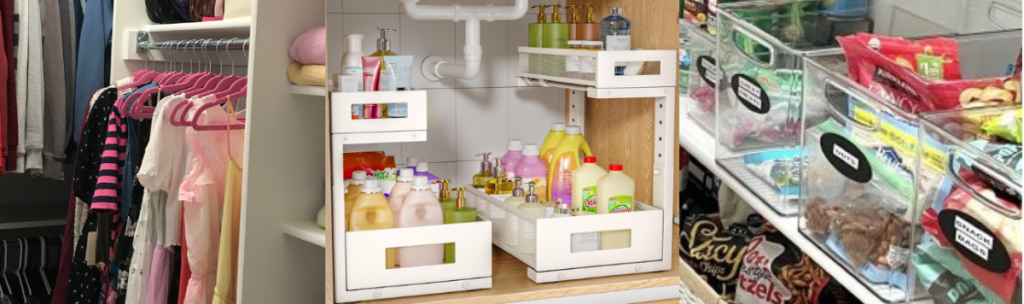
Best Organization Tools: My Favorite Products & Some to Avoid
Having organized the homes of hundreds of clients over the years, I know which home organizing products truly work and which ones to avoid. This post highlights the most functional products I consistently use and trust.

How to Declutter Your Wardrobe (And Skip the Seasonal Switch!)
By decluttering consistently, you will save yourself an enormous amount of time and energy by not having to rummage through seasonal clothing and move it in and out of your bedroom every time a new season rolls around.
0 Comments