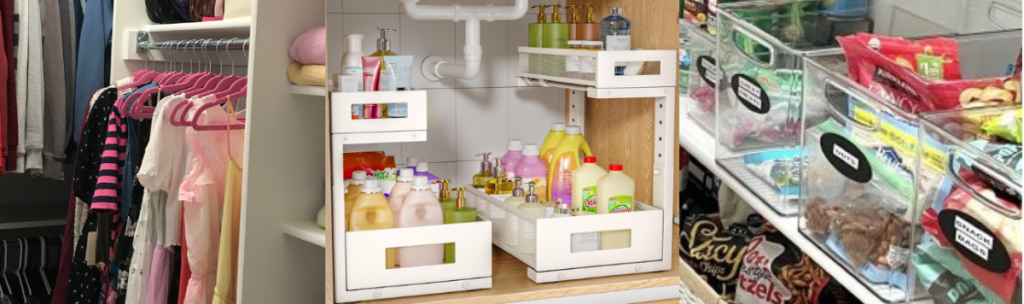
How to design a low-maintenance, ADHD-friendly home that practically runs itself.
By Laura Coufal/The Simple Daisy
Creating a home that “runs itself” isn’t about being more disciplined; it’s about reducing the number of decisions you have to make every day. By following these steps, you can design an ADHD-friendly home and transform your space from a source of stress into a place of support.
Curating a Supportive, ADHD-Friendly Home Design For You and Your Family:

Step #1 – Assess Your Home’s Clutter Threshold
I grew up in a somewhat minimalistic home. We weren’t trying to be minimalists (that wasn’t even a thing back then), but we lived in California, could only afford a smallish-sized home, and did not have much storage space. We had no basement or storage room, and a two-car garage, which also held our car and my dad’s large touring-style motorcycle. (Read my personal ADHD journey here).
We had to use the things that we owned or be willing to let them go. Though I didn’t know it at the time, it was likely this forced minimalistic style of living that helped me stay at least relatively organized (though still very forgetful) as a child growing up with ADHD. And I carried many of these simplistic habits into adulthood.
The more you own, the harder it is to keep it all organized. The less you own, the less you have to manage, organize, clean, and maintain. This is why inventory reduction is the most powerful action you can take to transform your home.
Lowering your home’s “Clutter Threshold” will put you on the fast track to an ADHD
-friendly home design:
Your home has a clutter threshold—the limit of what your home’s storage spaces can hold before the functionality of your home breaks down. Those of us with ADHD often have a lower personal clutter threshold because too much visual stimuli leads to immediate overwhelm. Be ruthless. Every object you own is a silent demand for your time, energy, and attention. Be sure to keep your home well under its clutter threshold. Aim for 70%-80% capacity.
1. Declutter “With a Vengeance.” Be ruthless about decluttering and be extremely selective about what you bring into your home. Less merchandise equals fewer decisions, less time spent organizing, and less work overall. Every object you own is a silent demand for space, time, energy, and attention. By decluttering, you are effectively “buying back” space and your future time.
2. Don’t Overstock. “Inventory overwhelm” happens when the amount of stuff exceeds our mental capacity to manage it. You can be prepared for anything, or you can be organized, but it’s hard to be both when you have ADHD.
Avoid bulk-buying items you don’t have room for. Buy replacements only when you are nearly out, and only buy what you have space for. Never store things in more than one place. For Example, don’t buy more food than what fits in your pantry and store the excess in your basement. Since most of us live within 10 minutes of a grocery store, let the store keep things for you until you need them.
3. Don’t Overfill Storage Areas. Cabinets and drawers that are filled to the brim are hard to maintain and keep organized. Over-nesting items in your kitchen (like bowls inside bowls) makes them hard to access and put away. Aim for 3 items or less.
On the other hand, storage spaces that are less than full are much more user-friendly and functional, and you’ll be able to minimize having to look for things hiding behind other things. Again, aim for 70%-80% capacity here as well. This “breathing room” allows you to see and grab what you need without causing a landslide of other objects.
4. Visibility is Important. For many of us ADHDers, when something leaves our visual field, it can quickly vanish from our mental radar. In other words, we need to be able to see it to remember that it is there. This is an object permanence issue—if we can’t see it, it basically ceases to exist. This leads to buying duplicates or forgetting we have tools until we no longer need them.
For this reason, visibility is helpful and even necessary for memory. When it comes to storage, the more you can see, the better. And this will be more achievable if you have less to store in the first place.
When you open up a cabinet door, you want to be able to quickly see and easily access everything that you have. In your pantry, if it is not overfilled and you use clear open-topped bins, you greatly increase your visibility.
5. Buy Services, Not Stuff. If you are struggling to keep up at home and loathe certain household tasks, invest your money in helpful services (like a cleaning person or a meal prep service) rather than more stuff. While these kinds of support services can be a wonderful helping hand, buying more stuff to manage and find space for will only sabotage your effort to keep up and stay organized. We often think a new organizing gadget will “fix” our problem, but this is a common organizing mistake. Usually, what we actually need is more time or less labor.

Step # 2 – Aim For Low Maintenance
Several steps can be taken to reduce the amount of work it takes to maintain a home. In this section, we’ll take a look at cleaning, laundry, and organizing tasks and how to make them easier to keep up with.
I honestly don’t spend a lot of time cleaning or organizing my home. I simply have our home set up in a manner that allows it to stay relatively clean, organized, and tidy (but not perfect) most of the time. Having less stuff also makes this easier to achieve.
I do have to take time regularly to tidy up and reset the space, but this typically only takes me about ten minutes. This is good for me because I spend so much time organizing other people’s homes that I don’t want to spend a lot of time doing this at home!
1. Store items exactly where you use them. If an item isn’t stored where it’s used, the effort to walk it across the house to put it away becomes a mental barrier.
Set up Activity Zones in your home and store everything that you need to perform that activity in that area. Examples: Keep your coffee mugs, coffee, and sugar directly above or beside the coffee maker. In your kitchen, you might have the following zones: baking, coffee, cooking, and food prep. Other examples of activity zones you can create in your home are: homework, toys/play, bill paying, crafts, etc.
2. Remove Physical Barriers. Make it as easy to put something away as it is to drop it on the floor. Use lidless baskets for toys, shoes, and towels. Place a large trash can in every room where trash tends to build up. Place a laundry hamper exactly where you naturally drop your clothes in your closet.
Every extra step (like unlatching a bin) is a chance to lose momentum. For a neurotypical person, opening a lid to put a toy away is a non-issue. For an ADHD brain, that lid is a hurdle that can cause us to stall. We need the path of least resistance.
3. Prioritize “Put-Away” Ease. When designing a system, focus on how easy it is to clean up rather than how easy it is to find something. If cleaning up is effortless, it actually gets done. This is especially true when it comes to kids’ clean-up tasks. When setting up spaces like your child’s bedroom or a toy room, ask: “How easy is it to put things away in this room?”
4. Let Go of High Maintenance and Low Pay Out Items. If an item requires a lot of time and effort to maintain, consider whether it’s worth keeping. Examples might be: a bunch of messy and mangy plants that need constant watering and clean-up, an above-ground pool that rarely gets used, or a large aquarium.
Give some deep thought to whether or not it still makes sense to keep these high-maintenance items, given the time, energy, space, and cost it requires. You might also want to evaluate your schedule for any endeavors that may be sucking your time and energy with little payout. Perhaps you own a small side business that requires a lot of time, effort, and inventory storage, with minimal profits. Would it simplify your schedule to let it go?
5. Reduce Your Workload. Take a critical look at your home’s required cleaning tasks and see what you can do to reduce your workload. For example, I had a couple of rugs in my kitchen, and I also have a couple of dogs that live in my house. I felt like I had to vacuum them constantly because they attracted dog hair like flies in a pigpen.
So one day, I replaced them with rubber foam rugs. No more hair. I eliminated that nearly daily cleaning task altogether. What can you replace or let go of to reduce the amount of work your home requires? Do you have a glass table that constantly needs cleaning because it shows every smudge?
Quick Cleaning Shortcuts:
🌼Clear surfaces make for easy cleaning. When your counters and tables are clear, a “deep clean” takes seconds. You can wipe the whole surface in one fluid motion. Every item on a surface adds 5–10 seconds to your cleaning time. If you have 20 knick-knacks on a shelf, you spend more time moving and dusting objects than actually cleaning the shelf.
🌼Less furniture and other knick-knacks equals less work. This makes dusting, vacuuming, and mopping tasks easier because you spend less time going around, moving, dusting, and cleaning underneath things.
🌼Removing the excess makes the room feel instantly tidier. Keep in mind that even if a room is technically clean, it still looks untidy if there is too much furniture and “stuff” everywhere.
6. Do you dread doing laundry and feel like you are always doing it? Those who own an abundance of clothing also struggle with keeping up with their laundry, ADHD or no ADHD. This is not a coincidence. Something happens here on a subconscious level. Basically, if we can afford to put off doing laundry without running out of clothing…then we do. The next thing we know, we’re up to our ears in it. If you own less clothing, you are forced to keep up with it, so you will never fall behind.
The same exact concept can be applied to doing dishes. If you only own a small number of dishes, you’ll never have to face a massive sink full of dishes to wash because you can’t afford to get that far behind. Remember that it is always easier to keep up than it is to catch up.

Step # 3 – Avoid Complicated Systems
My brain naturally tries to make things simpler, hence the name of my business…The Simple Daisy. I used to think I did this out of laziness, but I eventually realized that I actually developed this coping mechanism due to my ADHD and my inability to deal with lots of boring details. Now I recognize my need to simplify as a gift that can help others.
Complicated systems require patience and attention to detail, which people with ADHD often lack. They also typically require more maintenance. Focus on setting up simple, low-friction, high-sustainability systems that prioritize function over perfection.
1. Avoid Micro-Organizing. Broad categories are easier to maintain. Instead of sorting socks in little compartments by style, have one bin for black socks (no need to fold) and one for white ones. Let that be organized enough. When organizing, broader categories reduce decision fatigue. A filing system with 25 micro-categories is harder to set up and maintain than one with just a few broad categories.
2. Name Your Spaces. Label bins, shelves, and drawers. Once a permanent home has been assigned to an item, naming the storage space solidifies its purpose and helps your brain remember its “home.” In your bedroom dresser, you might have a drawer labeled “shorts drawer” or “pajama drawer”. Only store items that fit this category there. This will tell you exactly where an item lives, so you don’t have to think about it. Label the top, most accessible drawer in your bathroom “daily essentials” and store everything you use daily there.
Verbal labels act as external hard drives for your brain, but you can also place a physical label on a shelf, bin, or drawer to further reinforce its purpose. Once a bin is labeled “Lightbulbs,” or “batteries,” it feels “wrong” to put anything else there.
Once everything in your home has an assigned permanent home, you will stop losing things. You’ll no longer waste time looking for things. You’ll also stop wasting money and storage space buying things that you already have but can’t find.
3. Value Function Over Aesthetics. Social media has convinced us that a home isn’t organized unless it’s “Pinterest-perfect.” But high-maintenance systems are the enemy of sustainability. If you can find a system that is both beautiful, easy to maintain, and functional, that’s great! But don’t sacrifice beauty for efficiency.
Step # 4 Set Up Helpful Visual Cues
While those of us with ADHD often excel at hyper-focusing on what’s immediately in front of us (if it’s interesting to us), when something leaves our sight, it can quickly vanish from our mental radar. In other words, we need to be able to see it to remember that it is there. When it comes to getting things done, we also need it in our visual field to remember to do it.
I significantly improved my ability to remember to do things when I finally stopped trusting myself to remember things that were out of sight. Once I accepted this, I also stopped beating myself up every time I’d forget. Instead, I began setting up visual cues for myself. Visual cues really work.
1. Create visual cues for things you need to get done. Let’s say you need to return a library book, and can’t immediately drop everything to do it. Create an immediate visual reminder instead. For instance, place the book by the door where you’re sure to see it the next time you are leaving the house. If you realize you need to water the plants but can’t do it immediately, set the water pitcher by the sink so that when you do have time, you see it and remember to do it.
2. Set up digital visuals: Set recurring calendar reminders with pop-up alerts, use the alarm on your phone, or an Alexa device. The more you can get out of your head and make physical, the less you will forget.
3. Distinguish between “active clutter” (visual cues) and “inactive clutter.” Inactive clutter pertains to items that either have a home and need to be put away or have not yet been assigned a home. Either way, it serves no purpose in sitting out where you can see it. Active clutter is items you have intentionally set out as a visual cue for yourself. Try to minimize your inactive clutter to reduce a room’s overall “visual noise”.
4. Establish “Go Baskets” and hang hooks: Create designated visual spots for the things you need to take with you when you leave for the day. Install hooks by the door to hang your keys, purse, and jacket. A “Go Basket” (or launch pad) can hold your backpack, a water bottle, a lunch box, and other important items that you don’t want to forget. This is especially helpful if you have kids with ADHD.
5. Encourage your good habits. Pull habits you want to strengthen closer and push distractions out of reach. If you want to make an activity easier, put visual reminders front and center. For example, I want to eat more fruit, so I have a large fruit bowl sitting on my island. If I leave my fruit in the fridge, it is out of sight and out of mind, so it doesn’t get eaten.
Conclusion: Designing an ADHD-Friendly Home That You Love Spending Time In
At the end of the day, your home shouldn’t be another item on your to-do list. It should be the place where you go to recover from the world. For those of us with ADHD, the world is already loud, fast, and demanding; we don’t need our living rooms shouting at us, too.
By choosing to own less and simplifying your systems, you aren’t ‘giving up’ on having a nice home—you are finally choosing yourself over your stuff. You are trading the visual noise for mental quiet.
Remember, the goal isn’t to have a Pinterest-perfect house; it’s to create a space that supports your unique brain, forgives your bad days, and gives you the breathing room to actually enjoy your home. You deserve a home that feels like a sanctuary, not a struggle.
If you need some extra support, you might consider virtual ADHD organizing. If you can implement systems on your own as long as you have guidance and a plan of action, then taking this route might be just what you need to reach your goals.
Quick Start: 5-Minute Wins
Feeling inspired but not sure where to start? Pick just ONE of these tiny tasks to do right now:
🌼Surface Swipe: Pick one flat surface that “shouts” at you (like a coffee table or a kitchen counter). Clear everything off it except for what is absolutely necessary. Notice how much “quieter” that spot feels.
🌼Travel Test: Find one item you use every day that is stored across the room or in another area. Move its “home” to exactly where you use it. (Put the coffee scoop inside the coffee jar, or the mail opener right by the door).
🌼”High-Maintenance” Audit: Walk through your main living area and identify one object that makes you sigh because it’s hard to clean or move. Give yourself permission to put it in a “to-donate” box today.
🌼80% Capacity Check: Open your most-used drawer or cabinet. If it’s stuffed to the brim, remove three items you haven’t used in a month. Enjoy the new “breathing room” when you open it next time.
🌼Trash Sweep: Grab a trash bag and walk through just one room. Don’t organize, don’t “sort”—just look for actual trash. Making the room “empty” of waste is the fastest way to lower your clutter threshold.


About Laura
I am a Southern California turned small town, Midwest Mom. I am wife to Bruce and mom to my three girls.
Back when I first started my organizing journey in 2013, I had what I thought of as a dirty little secret. I have ADHD and although I am organized, and enjoy the process of sorting, and tidying. I knew that there were many others with ADHD who really struggled with staying organized. I had a case of imposter syndrome and mostly kept the fact that I had ADHD to myself. That is until I learned that there are other successful professional organizers who have also learned to compensate for their ADHD.
I eventually realized that my need for order and simplicity actually stems from having ADHD as a way to compensate for my short attention span. So my gifts and my challenges are all ironically tied together to create who I am, and I am able to relate to and help others as a result of this coping method that I have developed for myself.
I help women and moms with ADHD, but I also help those who struggle with clutter without having ADHD. Because simplicity and less clutter are always at the heart of staying organized, there is much overlap when it comes to finding solutions to clutter and disorganization.
I am dedicated to keeping my life as simple as possible and to helping others do the same by teaching them how to declutter their homes, simplify their lives, and manage their busy families better.
I hold a BA in Psychology and a CE (Coaching Essentials) Certification
Overwhelmed With Clutter? Get My Free Decluttering Kick-Start Kit and Start Making Progress Today!

Want Room-By-Room Guidance with Decluttering and Organizing Your Home?
If the state of your home is making your home life chaotic…if you are tired of being exhausted and overwhelmed. There is an easier path. Find out how decluttering your home, room by room can free you from forever feeling like you’re one step behind.
Get support from me just as if I were working there with you in your home.

organizing tips
7 Executive Functioning Skills Affected by ADHD (& How to Overcome Them)
The 7 Executive functions are cognitive processes that help us plan, organize, initiate tasks, manage time, stay focused, regulate emotions, and more.

Best Organization Tools: My Favorite Products & Some to Avoid
Having organized the homes of hundreds of clients over the years, I know which home organizing products truly work and which ones to avoid. This post highlights the most functional products I consistently use and trust.