How to Create ADHD Family Systems and Routines That Help You Manage Your Household:
By Laura Coufal/The Simple Daisy
How to Manage Household Chaos Without the Burnout
If your morning feels less like a ‘fresh start’ and more like a high-stakes search-and-rescue mission for missing shoes and signed permission slips, you aren’t failing—you’re likely just navigating an ADHD household with the wrong neurotypical tools.
As a professional organizer of 13 years with a B.A. in Psychology, and a fellow ADHD brain, I’ve spent the last decade learning that true peace doesn’t come from forcing your family into a rigid box. It comes from simplifying your home and building sustainable systems and routines in a way that aligns with how your brain processes information.
Whether it’s streamlining your kitchen for low-executive-function days, performing a Sunday reset, or simplifying the daily load of family life, it’s time to trade the chaos for a home that finally supports you, rather than managing a massive household workload you’re constantly trying to keep up with.”
Table of Contents
- Why Traditional Household Systems Fail the ADHD Brain.
- How to Get Past the Overwhelm and Build ADHD Family Systems and Routines.
- Create a kitchen that supports you.
- Meal Systems for Low-Executive-Function Days.
- Mastering Habits with ADHD.
- Conquering the Morning & School Rush
- Managing the Load of an ADHD Household: Cleaning and Laundry Hacks
- Final Thoughts: Building a Low-Maintenance, Sustainable Home.
Why Traditional Household Systems Fail the ADHD Brain.
Those with ADHD often have a lower threshold for overwhelm than those with neurotypical brains. Executive functioning skills like working memory, focus, and emotional regulation can all be impacted by ADHD.
Multitasking can also be more challenging for us. This is certainly true for me; multitasking slows me down significantly. I do better when I can hone in on one task at a time.
When multiple things are thrown at us at once, we can get flustered, and if pushed too far, progress can come to a complete stop. We become immobilized and unable to take another step. I found my younger self in this paralyzing place too many times to count.
When it comes to household chores and keeping up with all the tasks, such as laundry, decluttering, organizing, meal planning, and cleaning, if the head of the household becomes overwhelmed to the point of being unable to move forward, they may give up altogether.
When this happens, the rest of the family may follow suit and give up as well. Unfortunately, this is where the real chaos begins. When nobody’s trying, mass disorganization ensues. If you can relate, you’re not alone, and I encourage you to read on.
How to Get Past the Overwhelm and Build ADHD Family Systems and Routines:
The “Wall of Awful”.
It is easier to keep up than it is to catch up, and this is even more true for those with ADHD. That’s because task initiation is a common issue for ADHDers. Once a task becomes overwhelming, facing it feels insurmountable and daunting.
There are two ways to get past this: The first is to push past the inclination to stall and just start. I know this is easier said than done. Because getting started is always the hardest part. But once you’ve forced yourself to start, you are that much more likely to keep the momentum going, because “a body in motion stays in motion”.
Break Tasks Down Into Bite-Sized Pieces.
Next, break the job into manageable chunks. Even tiny chunks, if necessary. This will enable you to make progress without getting overwhelmed. It will also help you clearly see your progress, motivating you to continue.
If you are attempting to declutter a large closet, it can feel like an overwhelming task. What you don’t want to do is take everything out all at once and dive in. Instead, work on decluttering only the hanging clothing on one side of the closet. Ignore everything else while you are doing this. Don’t move on until you’re finished.
Next, tackle only the clothing hanging on the other side. Once that’s done, move on to shoes, etc. It’s less daunting to plan to complete one small task at a time than to envision taking on the whole 3-hour job at once. If the job still seems overwhelming, break it down even further. Tell yourself you’re just going to work on your closet for 5 or 10 minutes a day. This way, you will still be moving forward and making progress.
Transition from “Perfect” to “Functional .”
Your home should be a support system, not a trophy case. I used to think that being a perfectionist was a virtue, and that having high expectations and working hard to do our very best led to success. Now, I know this to be only partly true.
Perfectionism can also be a trap. High expectations can cause “analysis paralysis,” keeping projects at a standstill before they even begin.
The fix? Step out of your comfort zone and push through the friction. A finished project—even an imperfect one—is always better than a “perfect” idea that never leaves your head.
Value Function Over Aesthetics.
Think the opposite of the Home Edit. Don’t aim for a “Pinterest-perfect” pantry if it’s too hard to maintain. If a system is high-maintenance, it’s not for your family. Instead, aim for functionality, efficiency, and easy maintenance.
Less is more when it comes to Clutter and ADHD.
The more stuff you have in your home, the harder it will be to keep it all organized. For those with ADHD, visual clutter is even more overwhelming than it is for those with neurotypical brains.
If I were to give you one tip to take action on, this one would have the greatest impact on helping your family stay organized. Take a critical eye to every single thing in your home and acquire new items very selectively. Because less is truly more if you/and your family members have ADHD. The less excess clutter you have in your home, the easier it will be to maintain. By keeping your home well under exceeding its clutter threshold, your storage spaces will remain functional and easy to navigate.

Create a kitchen that supports you:
The kitchen is the family hub and often the most important room in the house. A lot happens here. Focus on organizing everything in your kitchen so it is easy to find, access, and put away.
Create activity zones for meal prep, baking, cooking, etc., by storing things where you use them. This will make dinner preparation easier for you. It is much easier to cook in a kitchen that is orderly and clutter-free. You want to be able to find all the ingredients you’ll be using quickly to streamline the process.
Don’t cram too many things into your cabinets and drawers.
Otherwise, it will be impossible to keep everything visible and find things quickly. You’ll also want to avoid hiding things from yourself by storing things behind other things. For many of us with ADHD, if it is out of sight, it doesn’t exist.
Streamline Your Pantry Organization.
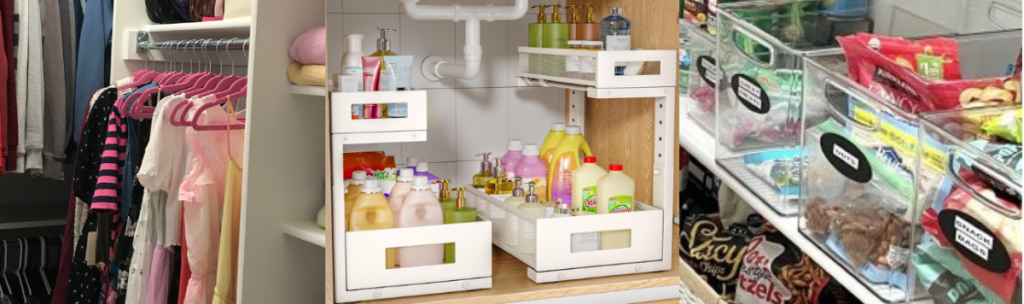
Ensure that your pantry is ADHD-Friendly by making everything visible. Keep categories together using clear, open-topped bins and labels and tiered shelving for canned foods. DO NOT OVER STOCK. This is where lots of families get snagged. They go a little crazy at Cosco, run out of space, and suddenly, they have lost control of their inventory and can’t find anything. And what happens when things get lost? They buy more.
Meal Systems for Low-Executive-Function Days:
Take time to meal plan.
Though meal planning can be challenging, training yourself to get in the habit is important so that the weekly task becomes more automatic.
Once you’ve mastered this, it will make your life so much easier. You’ll be able to avoid unnecessary last-minute decision-making and the feeling of being overwhelmed that goes with it.
How to Remove the Friction:
At the end of a long day, it can feel exhausting to make all the decisions needed to get dinner on the table. Meal planning isn’t just about recipes; it’s about reducing the number of decisions you have to make in the first place.
Keep it simple.
Choose simple supper recipes that are easy to prepare and require minimal ingredients. Avoid overly complex or time-consuming meals. Like my high-protein, low-stress Salisbury Steak for a 20-minute win or my super simple and delicious 4 Ingredient Creamy Italian Chicken. The goal is to get a healthy meal on the table.
Honestly, it’s the meals that are the easiest to prepare that my kids end up liking the most! Read my post: ADHD Friendly Meal Planning Tips to Make Dinnertime Easier, to get more meal planning tips.
Mastering Habits with ADHD:
Building habits with ADHD can feel like an uphill battle, but it’s one worth fighting. While many ADHDers feel routines are impossible, they are actually essential tools for staying afloat and organized. Yes, habit formation is objectively harder for neurodivergent brains, but it is achievable.
You’ll Want to Quit…But Don’t
New habits are difficult because they challenge established neural pathways. Since ADHD brains are wired for novelty, they get bored or distracted easily. When you feel that urge to quit, push yourself to stick with it just a little longer. Over time, that friction will fade, and the habit will become second nature.
Choose Grace Over Guilt
When you inevitably slip up, be kind to yourself. Shaming yourself for a “missed day” only leads to paralysis and sabotage. Instead of beating yourself up, simply dust yourself off and restart. Progress isn’t about perfection; it’s about getting back on track.

Conquering the Morning & School Rush:
A little planning ahead can go a long way in making the weeks go by more smoothly. By putting some helpful ADHD friendly school family routines into place, you can help your family avoid stress and feel more in control as the weeks roll by.
Establish a Launching Pad.
Since forgetfulness is common for many kids with ADHD, -this was a BIG issue for me, by the way– Create a system by the door to help each family member remember the items that need to go with them to school each day. Create one launching pad for each family member.
A launching pad can be created by placing a bin or basket by the door. This will be a dedicated zone for backpacks, keys, and shoes, lunches, coats, musical instruments, sports equipment, and anything else that needs to go with them each day.
Never Underestimate The Power of The To-Do List:
A list can be an extremely helpful aid for helping you and your family get things done. They provide a visual cue and allow your mind to relax because you don’t have to keep thinking about what not to forget.
For kids, a detailed to-do list will help them focus, stay on track, and not forget things. As a bonus, as your child checks off important tasks that need to get done each day, they’ll get a little dopamine boost, which will motivate them to keep going. A very detailed list, with each small step explained carefully, will ensure your child’s success.
Organizing systems should serve your family, not the other way around, so lean in to your family’s dumping habits.
See if you can find a way to store things where they tend to land rather than constantly moving things back to a different location. If shoes seem to end up by the back door, put a shoe rack there. If coats or backpacks constantly land on the chair near the front door, install hooks on the wall near there.
If keys, wallets, and mail constantly pile up on the table in the livingroom by the front door, place 2 open-topped decorative bins on the table, one to catch the keys and wallet, and another to house the mail until you have time to go through it. The first bin will also serve as a designated home for important items like keys, phones, and wallets, so that they don’t get lost.
If your kids’ schoolwork and artwork ends up all over the dining room table, set an open-topped bin in a nearby location for them to toss school paperwork into.
The 10-Minute Family Reset.
Here’s an excellent hack for keeping your home clutter-free without the burnout: try a daily 10-minute family tidy session. A tidy home doesn’t require a marathon; it just takes a helpful daily habit.
Get the whole family involved in a consistent, 10-minute daily tidying session—ideally right before or after dinner. You will be amazed at how quickly your home will come together when each family member pitches in for just 10 minutes a day!
Make it stick by gamifying the task by playing fun music or setting a timer. This will turn the chore into a race against the clock. When the 10 minutes are up, be sure to stop. Honoring the time limit prevents burnout and ensures your family remains willing to participate tomorrow.

Managing the Never-Ending “Invisible Load” of an ADHD Household: Cleaning and Laundry Hacks:
How to Keep Up With The Dreaded Laundry.
Laundry doesn’t have to be a constant dark cloud over your week. Here is a streamlined guide to taking back control. First, Shrink Your Wardrobe. Owning an abundance of clothes is a trap I see all too often.
When you have enough clothing to avoid doing laundry for weeks, the eventual pile-up becomes overwhelming. A smaller wardrobe forces you to keep up and avoid laundry avalanches. You’ll be shocked at what a difference this one factor makes. Less clothing makes for substantially less work.
Try Caiming Your Laundry Day.
Instead of attempting to do a little each day, pick one specific day of the week and declare that day laundry day from here forward. This trains your brain to automate the habit. Do all your laundry on this day. This will free you from having to think about laundry the other six days of the week! I love this bonus! You will want to get caught up on your laundry before you do this.
Reduce Your Overall Workload.
Stop washing towels after a single use. Since your body is clean when you dry off, reuse your towel until the end of the week and instruct your family to do the same. You’ll save water, electricity, and significant time—plus, your towels will last much longer. Stop washing clothing unless they are noticably stained or smelly. Stop folding underwear and socks; instead, just toss them into bins placed inside your drawers.
Make Cleaning Tasks Easier For Yourself.
Use a system to remind yourself to do household tasks. Put cleaning tasks on your calendar so that you remember to do them. This is especially helpful for cleaning tasks you don’t enjoy or forget often. I use my Google calendar and have it linked to my email so that I also get an email reminder. Once you get something on the calendar, it is more likely to get done.
Create a To-Do list so that you can check off cleaning tasks as you go:
To-do lists are also excellent for helping you stay focused. Your list might look like this for a kitchen:
- Pick up trash.
- Put dishes in the sink.
- Clear clutter from countertops and tables.
- Wash dishes, empty/fill dishwasher.
- Wipe down/disinfect countertops.
- Sweep Floor.
- Mop floor.
- Empty trash.
When it comes to household chores, teamwork is best.
By assigning household chores to kids, you are not only helping yourself, but you are teaching your kids to be responsible for completing daily tasks. These skills become helpful habits that carry over into adulthood.
These days, many families are so busy that all hands are needed on deck just to keep up, and this is even more true if ADHD is in the mix. Families function best with routines and when everyone within the family unit understands their role and responsibility as a family member to contribute and do their part.
Being consistent with delegating household cleaning tasks to your children will help your family stay organized and on top of things. And this will go a long way to lower stress levels and promote peace in the home.
Final Thoughts: Building a Low-Maintenance, Sustainable Home
Managing a family with ADHD is undeniably challenging, but remember: your worth is not measured by the height of your laundry pile or the perfection of your pantry. For years, you may have tried to force your vibrant, divergent brain into a “neurotypical box” that simply wasn’t built for you.
If those systems failed, it wasn’t a lack of willpower—it was a mismatch of tools. By embracing these functional, ADHD-friendly strategies, you aren’t just tidying a room; you are reclaiming your peace of mind, avoiding burnout, and modeling self-compassion for your children.
Carry This With You:
- Progress Over Perfection: An “imperfect” system that you actually use is infinitely better than a “perfect” one that stays in your head.
- Small Wins Matter: A 10-minute reset or one day named “Laundry Day” might seem small, but these are the bricks that build a sustainable life.
- You Are the Expert: You know your family best. Lean into what works, discard what doesn’t, and always choose grace over guilt.
You’ve spent enough time fighting against your home. It’s finally time to let your home start fighting for you. You’ve got this. If you need additional support and guidance, you might consider virtual organizing, an accountability partner might be just what you need to help you reach your goals.


About Laura
I am a Southern California turned small town, Midwest Mom. I am wife to Bruce and mom to my three girls.
Back when I first started my organizing journey in 2013, I had what I thought of as a dirty little secret. I have ADHD and although I am organized, and enjoy the process of sorting, and tidying. I knew that there were many others with ADHD who really struggled with staying organized. I had a case of imposter syndrome and mostly kept the fact that I had ADHD to myself. That is until I learned that there are other successful professional organizers who have also learned to compensate for their ADHD.
I eventually realized that my need for order and simplicity actually stems from having ADHD as a way to compensate for my short attention span. So my gifts and my challenges are all ironically tied together to create who I am, and I am able to relate to and help others as a result of this coping method that I have developed for myself.
I help women and moms with ADHD, but I also help those who struggle with clutter without having ADHD. Because simplicity and less clutter are always at the heart of staying organized, there is much overlap when it comes to finding solutions to clutter and disorganization.
I am dedicated to keeping my life as simple as possible and to helping others do the same by teaching them how to declutter their homes, simplify their lives, and manage their busy families better.
I hold a BA in Psychology and a CE (Coaching Essentials) Certification
Overwhelmed With Clutter? Get My Free Decluttering Kick-Start Kit and Start Making Progress Today!

Want Room-By-Room Guidance with Decluttering and Organizing Your Home?
If the state of your home is making your home life chaotic…if you are tired of being exhausted and overwhelmed. There is an easier path. Find out how decluttering your home, room by room can free you from forever feeling like you’re one step behind.
Get support from me just as if I were working there with you in your home.

organizing tips
7 Executive Functioning Skills Affected by ADHD (& How to Overcome Them)
The 7 Executive functions are cognitive processes that help us plan, organize, initiate tasks, manage time, stay focused, regulate emotions, and more.

Best Organization Tools: My Favorite Products & Some to Avoid
Having organized the homes of hundreds of clients over the years, I know which home organizing products truly work and which ones to avoid. This post highlights the most functional products I consistently use and trust.