
Cleaning | Decluttering
13 Stress-Free Spring Cleaning and Decluttering Tips & Checklist
This post may contain affiliate links. I may receive a commission, at no cost to you, when you choose to use the links provided. See my privacy policy for more information.

Spring cleaning and decluttering tips to help you lighten up your home:
Since I am not a winter person, I am always more than ready to put winter behind me and embrace the warmer weather. Spring is also the perfect time to lighten up and brighten up your home for a fresh start. Use these spring cleaning and decluttering tips to get the job done stress-free.
1. Declutter before you clean.
You will be able to clean more thoroughly if you get rid of all the excess clutter sitting around your home first. So always tackle decluttering before you clean your house.
2. If you have a whole house to declutter, avoid starting with a challenging category of clutter.
Generally, keepsakes, photos, and paperwork are all more difficult to tackle. It takes much longer to go through paper and photos than it takes to declutter your pantry. Also, keepsakes and photos usually have so many emotions tied to them that decision-making is more difficult.
To make more rapid progress, choose a smaller, more manageable space like your bathroom, kitchen, pantry, or hall closet. Typically, it is much easier to make decisions about nearly empty bottles of shampoo and expired food than your keepsakes.
3. Break the job into small chunks.
If you have a large amount of decluttering to do, don’t try to take on the whole house at one time. This will not only be overwhelming, but it’s also less rewarding at the end of the day because it is harder to see your progress. Instead, focus on one small area at a time.
Move on to another area only after you have completed the first. This will help you see the tangible results of your work, motivating you to keep going.
4. Avoid the “shuffling” trap.
Be careful not to make the mistake of moving items from room to room instead of deciding what to do with them all. If you do this, you will never finish decluttering! This is a common decluttering mistake.
It is so easy to make this mistake because it is harder to make decisions about what to do with something than it is to just move it around. But if you are only postponing decisions, no real progress is being made.
If you decide to keep something, determine a permanent home for it. If you can’t find a place to store it because your storage spaces are already full, this may be a sign that you have too much stuff. Your home has likely exceeded its clutter threshold.
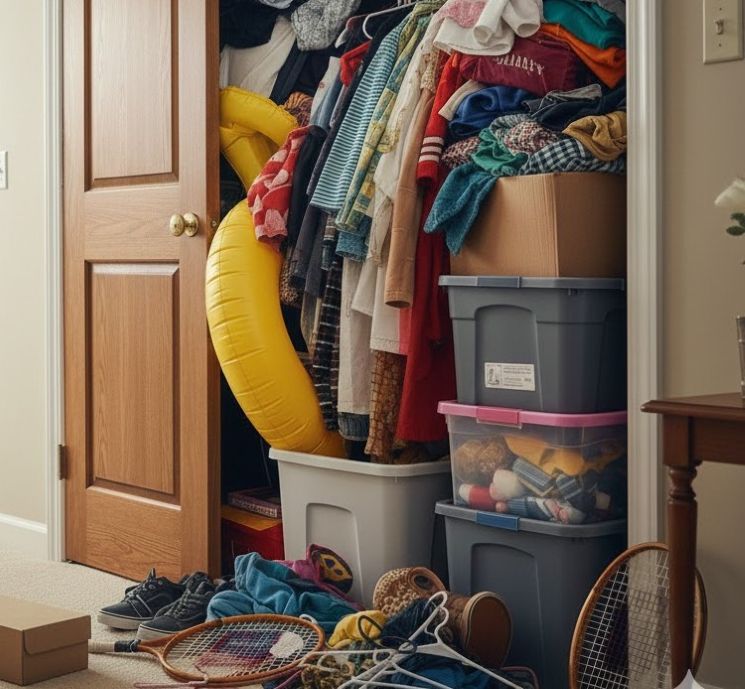
5. Determine if your house has exceeded its clutter threshold.
Once your home has exceeded its clutter threshold and its storage spaces are overfilled, items begin to accumulate in visual places. This is typically when your home will also start to feel chaotic and disorganized.
Evaluate your home’s storage spaces like closets, drawers, and cabinets. If they are filled to the brim, it might be time to do a deep cleanout and declutter your storage spaces.
Here are three signs your home has exceeded its clutter threshold:
1. Every time you open a closet, drawer, or cabinet door, things spill out. It’s a hassle to find things inside these storage spaces because too much stuff is crammed in there.
2. Every time you tidy up your home and get everything put away, it all seems to return in no time.
3. Multiple items never even get put away because you don’t have a place to put them. Instead, they sit out in the open, on floors and countertops, making your home look and feel cluttered.
6. Establish a donation box for your family.
Keep a donation box in a designated location in your home year-round. This will allow you and your family to toss no longer used items in the box as they come across them.
This is a simple trick that will prevent unwanted items from getting shoved back into drawers or closets. If everyone in your family knows about the box, you will be surprised at how fast it fills up.
The donation box becomes an automatic tool that helps you declutter your home. Then all you have to do is get the boxes in your car and drop them off at a charity.
7. Do not wait, donate.
If you have things you are holding onto because you want to have a garage sale or sell by another means, evaluate whether or not the money you will make selling these items is really worth the time and effort. A garage sale takes a lot of time and planning. Worst of all, it becomes a barrier to exit for your clutter.
By choosing to donate, you free up precious space, and you declutter your home immediately. Donating is the quickest way to get rid of the clutter and save yourself the headache of selling the items. You also come away with knowing that you made a difference by helping those in need.
Once your home has been decluttered, be vigilant about what you and your family bring back into your home. These days, it is all too easy to shop and acquire until your home is filled to the brim.
Move on to spring cleaning once decluttering is done:
8. To make progress faster, clean your house task by task, not room by room.
It takes less time to apply a task to your whole house than to clean one room at a time. For example, when you vacuum, vacuum the whole house. It takes too long to clean one room at a time.
9. Clean from the top down.
To avoid doing double the work, always follow the Top-to-Bottom rule. Start at the highest points in a room—like ceiling fans, and the tops of bookshelves—and work your way down to the baseboards. Since gravity naturally pulls dust and allergens downward as you clean, this method ensures that dust particles land on surfaces you haven’t tackled yet.
Follow this specific order to save time:
- Clear the decks: Pick up any stray trash or laundry first so your path is clear.
- High-intensity areas: Clean the bathrooms and kitchen next.
- The Great Dust-Down: Dust the whole house, starting from the ceiling down to the furniture.
- The Final Sweep: Finish by vacuuming and mopping all the floors. By the time you reach the ground, you’ll have captured all that fallen debris in one final, satisfying sweep!
10. Tackle the invisible dust catchers.
Most people forget to dust the following areas that affect air quality:
-
Dust Ceiling Fans with a Pillowcase: Slide an old pillowcase over each blade and pull it back. The dust stays inside the bag instead of falling on your face or the freshly cleaned floor.
-
Vacuum Refrigerator Coils: A quick vacuum of the coils (usually behind or underneath) helps the fridge run more efficiently, saving money and extending the life of the appliance.
-
Swap Your HVAC Filters: Spring is the best time to change air filters to catch all that new pollen.
11. Vinegar and baking soda are excellent natural cleaning products.
Vinegar and baking soda will clean just about everything in your home and do a better job! Vinegar and baking soda are gentle, natural, more environmentally friendly, and less costly. I now use these two products on nearly everything in my home.
Baking soda is perfect for anything that needs a porous scrub, like bathtubs and kitchen sinks. White vinegar diluted with a little water in a spray bottle creates a powerful multi-surface cleaning product. I use 2 parts vinegar – 1 part water. This vinegar solution can be used on sinks, mirrors, cabinets, floors, showers, and much more.
Since vinegar and water are gentle and effective on so many surfaces, you can buy less of all those other products and save more storage space.
12. Get your bathroom and kitchen sinks clean fast using this method.
Spray the entire sink and faucet with a vinegar and water solution. Let it sit for a few minutes to loosen stains and hard water deposits. Use the porous side of a scratch-free sponge to scrub the sink and faucet. Rinse with water. Wipe the sink dry with a clean cotton cloth and revel at how sparkling clean it is!
If your sink is extremely soiled, you can use a small amount of baking soda and the porous side of a scratch-free scrub sponge to scrub it clean before spraying it with vinegar and water.
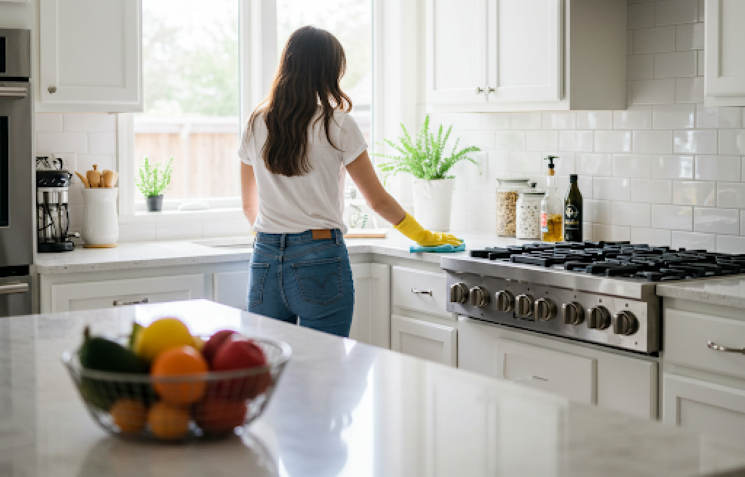
13. Follow these steps to get hardwood floors sparkling clean.
You can use vinegar and water in a bucket and a mop to safely clean your hardwood floors. Use half a cup of white vinegar and a gallon bucket of warm water. Use a mop that allows you to easily access nooks and crannies. I prefer to use a Rubbermaid self-wringing mop because it is durable, long-lasting, and cleans well.
Make sure you don’t get your wood floors too wet, as water can potentially cause warping or deterioration. I avoid using disposable floor-mopping products. They may be quick, but they don’t do a good job, are costly, and they’re not environmentally friendly.
Here’s a Cleaning and Decluttering Checklist to Help You Get Started:
Use this checklist to move through your home intentionally. For the best results, remember to finish the decluttering section entirely before moving on to the cleaning tasks!
Start With Decluttering:
- [ ] Set Up Your Donation Box: Place a box in a central location for items you no longer need.
- [ ] Pick One “Easy” Space: Start with a simple category like the pantry, bathroom cabinet, or hall closet.
- [ ] The “No Shuffling” Sweep: Pick up items that don’t have a home and decide right now: Keep and give it a permanent spot, or Donate.
- [ ] Check Your Storage Limits: Open one drawer or cabinet that feels “full.” If items spill out, remove 3–5 things to donate to bring it back under your clutter threshold.
- [ ] The Final Exit: Put your donation boxes in the car and drop them off today.
Whole-House Cleaning List:
To save time, complete each task for the entire house before moving to the next.
- [ ] Trash & Laundry: Walk through every room with a trash bag and a laundry basket to clear all surfaces.
- [ ] Top-to-Bottom Dust: Starting with the highest shelves or fans, dust all surfaces so the debris falls to the floor.
- [ ] Kitchen Surfaces: Scrub sink with your vinegar solution and wipe clean. Spray and wipe down countertops, appliances, back splash, stovetops, and other exterior surfaces.
- [ ] Bathrooms: Spray mirrors and sinks with your vinegar solution. Wipe down countertops. For stubborn spots, use a sprinkle of baking soda and a scratch-free sponge. Scrub sinks, toilets, showers, and tubs.
- [ ] Sweep Floors: Vacuum or sweep every room in the house to pick up everything that was dusted down.
- [ ] Mop Floors: Use a damp (not wet) mop with a simple vinegar and warm water solution to make your floors sparkle.
Ultimately, the secret to a stress-free declutter and clean is to stop the ‘shuffling trap’ and start making decisions. Pick one small area to start with today, and break the job down into small, manageable chunks to avoid getting overwhelmed. This is especially important if you are trying to clean your home with ADHD. By following these 13 tips to declutter and deep clean naturally, you’ll transform your living space and refresh your home just in time for spring.


About Laura
I am a Southern California turned small town, Midwest Mom. I am wife to Bruce and mom to my three girls.
Back when I first started my organizing journey in 2013, I had what I thought of as a dirty little secret. I have ADHD and although I am organized, and enjoy the process of sorting, and tidying. I knew that there were many others with ADHD who really struggled with staying organized. I had a case of imposter syndrome and mostly kept the fact that I had ADHD to myself. That is until I learned that there are other successful professional organizers who have also learned to compensate for their ADHD.
I eventually realized that my need for order and simplicity actually stems from having ADHD as a way to compensate for my short attention span. So my gifts and my challenges are all ironically tied together to create who I am, and I am able to relate to and help others as a result of this coping method that I have developed for myself.
I help women and moms with ADHD, but I also help those who struggle with clutter without having ADHD. Because simplicity and less clutter are always at the heart of staying organized, there is much overlap when it comes to finding solutions to clutter and disorganization.
I am dedicated to keeping my life as simple as possible and to helping others do the same by teaching them how to declutter their homes, simplify their lives, and manage their busy families better.
I have been helping others stay organized since 2013.
It is my deepest hope that you will find resources here that will bring you closer to living a simpler, more intentional, and more peaceful life.
always have
something
beautiful
in your space…
…but let it be
as simple
as a daisy
in a vase.
Overwhelmed With Clutter? Get My Free Decluttering Kick-Start Kit and Start Making Progress Today!

Schedule a coaching call, virtual organizing session, or a home assessment with me, and get the support and encouragement you need to move forward.

you may also like

How to Declutter Your Wardrobe (And Skip the Seasonal Switch!)
By decluttering consistently, you will save yourself an enormous amount of time and energy by not having to rummage through seasonal clothing and move it in and out of your bedroom every time a new season rolls around.
How to Organize and Declutter a Child’s Bedroom Without the Meltdowns
If you feel like decluttering your child’s bedroom is an uphill battle, here are some suggestions to help you make progress and get the job done.

Overwhelmed by a Messy House? 16 Cleaning Motivation Tips
This post may contain affiliate links. I may receive a commission, at no cost to you, when you choose to use the links provided. See my privacy policy for more information. Cleaning Motivation Tips to Help You Get a Handle on Your Home If you’d rather have a...
0 Comments